

SDG&E Demand Charges: The Silent Margin Killer for San Diego Multifamily

San Diego multifamily owners are currently operating in one of the most punitive utility environments in the United States. While the headlines often focus on the escalating price per kilowatt-hour (kWh) for residential ratepayers, sophisticated asset managers in the San Diego Gas & Electric (SDG&E) territory know that the real threat to a property’s net operating income (NOI) isn't just consumption: it’s the demand charge. In the commercial and large-scale residential asset classes, these charges represent a structural OpEx volatility that can quietly erode 30% to 50% of a building’s monthly power bill, regardless of how "efficient" your lighting or HVAC systems claim to be.
If you are underwriting a value-add acquisition in North Park, managing a stabilized class-A high-rise in Little Italy, or overseeing a sprawling garden-style portfolio in Mission Valley, ignoring the demand charge is a fundamental underwriting error. In an era where cap rates are under pressure and exit valuations are scrutinized, leaving your energy infrastructure exposed to the 15-minute peaks of the SDG&E grid is no longer just a "cost of doing business": it’s a failure to protect the margin.
The Infrastructure Lever: Understanding the Demand Charge Trap
To manage the risk, you have to understand the calculation. Unlike standard residential billing, where you pay for the total volume of energy used over a month, commercial and multifamily "Master Meter" accounts are hit with demand charges based on the single highest 15-minute window of usage during the billing cycle.
Think of it this way: if energy consumption is the volume of water flowing through a pipe, the demand charge is the width of the pipe itself. SDG&E charges you for the maximum capacity they must reserve for your property at any given moment. If every tenant in your 120-unit complex turns on their AC at 5:30 PM while the elevators are running and the parking garage fans kick in, you’ve set a new "peak." Even if you drastically reduce your usage for the rest of the month, you are billed based on that one 15-minute spike.
This is why traditional energy efficiency measures: LEDs, low-flow fixtures, or even better insulation: often fail to move the needle on the bottom line. You might reduce the volume of energy used (kWh), but if you don't address the intensity of that usage (kW), your demand charges remain high. This is the infrastructure lever that most San Diego owners miss, a topic we explore further in our deep dive on how to Increase NOI Commercial Property: The Infrastructure Lever Most San Diego Owners Miss.
Underwriting Risk: The Volatility Factor
From an institutional perspective, predictability is as valuable as the absolute dollar amount. When a property is subject to demand charges, its OpEx becomes inherently volatile. A heatwave in August doesn't just increase usage; it creates a massive demand spike that sets the floor for the bill.
When you are preparing a Pro-Forma for a 5-year or 7-year hold, how are you accounting for SDG&E’s shifting rate structures? Most analysts simply plug in a 3% or 5% annual escalation for utilities. This is a dangerous assumption in San Diego. The demand charge is a moving target that can fluctuate wildly based on tenant behavior and grid conditions. For a GP (General Partner) reporting to LPs (Limited Partners), explaining a 20% miss in utility projections because of a "silent" demand charge is a difficult conversation.
By treating energy as a fixed infrastructure component rather than a variable utility expense, you de-risk the asset. Converting your rooftop from a maintenance liability into a revenue-generating or cost-mitigating asset is the core of our Rooftops Into Revenue™ strategy. It’s about taking control of the meter.

The NOI Math: A San Diego Case Study
Let’s look at the actual numbers. Assume you own a mid-sized multifamily asset in San Diego with a Master Meter configuration.
Pre-Infrastructure Upgrade Monthly Snapshot:
Total Energy Consumption (kWh): 60,000 kWh
Energy Cost (@ $0.18/kWh avg): $10,800
Monthly Peak Demand: 180 kW
Demand Charge Rate (@ $25/kW): $4,500
Total Monthly Utility Bill: $15,300
In this scenario, the demand charge represents roughly 29% of the total bill.
Now, consider the implementation of a commercial-grade solar and battery storage system designed specifically for "Peak Shaving." The goal is not just to generate power, but to use the battery to discharge energy during those 15-minute peak windows, effectively "shaving" the peak that SDG&E sees at the meter.
Post-Infrastructure Upgrade Monthly Snapshot:
Solar Production Offset: 40% reduction in kWh purchased from the grid.
Peak Demand Shaved: Reduced from 180 kW to 90 kW (using automated battery discharge).
New Energy Cost: $6,480
New Demand Charge: $2,250
New Monthly Utility Bill: $8,730
Monthly NOI Increase: $6,570 Annual NOI Increase: $78,840
This is where the math gets interesting for the ownership group. This isn't just "saving money on electricity." This is a direct injection into the asset's performance.
The Cap Rate Multiplier: Building Equity Out of Thin Air
The value of any commercial real estate asset is a function of its NOI divided by the market cap rate. In the current San Diego market, where multifamily cap rates are compressed, every dollar of NOI is amplified significantly.
If we take the annual savings from the example above: $78,840: and apply a 5.25% cap rate (a standard benchmark for stabilized San Diego multifamily), the impact on the asset's valuation is staggering:
$78,840 (NOI) / 0.0525 (Cap Rate) = $1,501,714 in Added Asset Value.
By addressing the "silent margin killer" of demand charges, you haven't just lowered an expense. You have increased the terminal value of your property by over $1.5 million. This is equity created through infrastructure, independent of market rent growth or tenant turnover. For owners looking to refinance or sell in the next 24 to 36 months, this is the most efficient way to "manufacture" equity in a high-interest-rate environment.
You can run your own numbers and see the potential lift using our Rooftops Into Revenue™ Model.

Why Battery is the Control Layer Under NBT
The transition to California’s Net Billing Tariff (NBT) has fundamentally changed the logic of commercial solar installation in San Diego. Under previous rules (NEM 2.0), solar without a battery still made financial sense because the grid acted as a "virtual battery" with a 1-to-1 credit system. Those days are over.
Under NBT, the value of the energy you export back to the grid is significantly lower than the price you pay to pull energy from it. This is why battery storage is no longer an "optional add-on": it is the critical control layer.
For a multifamily property, the battery serves two roles:
Arbitrage: Storing solar energy produced during the day (when it’s "cheap") and using it during evening peak periods (when it’s expensive).
Demand Management: This is the primary weapon against SDG&E demand charges. The system’s software monitors the building’s draw in real-time. The moment it detects a spike that would trigger a higher demand charge tier, the battery kicks in to provide that power locally, keeping the meter reading low.
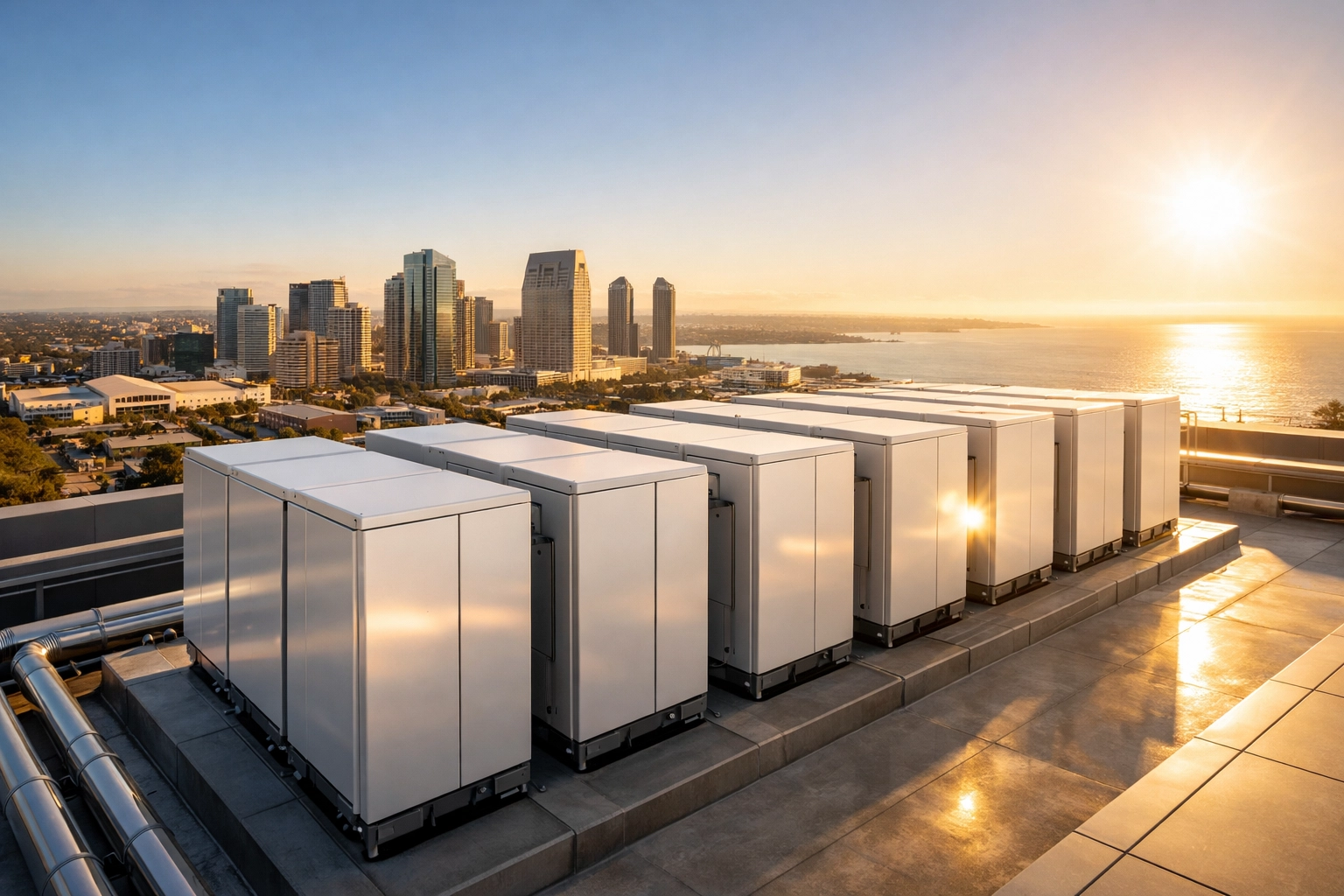
Without the battery, a solar system might reduce your overall energy consumption, but it will do very little to stop the demand charge spikes that happen when the sun goes down and tenants return home to use high-draw appliances. To understand the technical requirements of this setup, see our article on Commercial Solar Installation San Diego: Why Battery Is the Control Layer Under NBT.
Strategic Implementation: Moving Beyond "Solar Sales"
The mistake many San Diego property owners make is engaging with residential-focused solar companies that happen to do "some commercial." Commercial solar and storage is an infrastructure project, not a home improvement job. It requires a deep understanding of:
Complex Metering: Dealing with Master Meters, Virtual Net Metering (VNEM), and tenant sub-metering.
Interconnection Logistics: Navigating SDG&E’s commercial interconnection department, which is notoriously slow and technically demanding.
Structural and Electrical Engineering: Evaluating large-scale flat roofs and aging switchgear to ensure the property can handle the new load profile.
Financial Structuring: Understanding how to align the system’s cost with the property's tax strategy and long-term hold goals.
At Save On Solar Now, we don't look at your roof and see a place for panels; we look at your pro-forma and see a place for margin recovery. We specialize in the San Diego market because we know exactly how SDG&E’s rate schedules (like the AL-TOU or DG-R) can be optimized.
Conclusion: Take Control of Your OpEx
Demand charges are a tax on the unprepared. In the competitive San Diego multifamily landscape, the delta between a high-performing asset and a struggling one often comes down to OpEx management. If you are allowing SDG&E’s demand charge structure to dictate your monthly margins, you are leaving money on the table and leaving your asset value to chance.
The technology exists to eliminate this volatility. The math supports the investment. And the cap rate multiplier makes it the most logical move an owner can make in 2026.
Stop letting demand charges kill your margins. It’s time to move energy from the "uncontrollable expense" column to the "strategic asset" column.
America’s Rooftop Revenue Experts™
Execute the Model for Your Portfolio: Run Your Rooftops Into Revenue™ Model at https://www.getsosnow.com/rir?utm_source=blog&utm_medium=content&utm_campaign=demand_charges_killer
Direct Asset Consultation: 📞 (858) 400-3524

Comments